
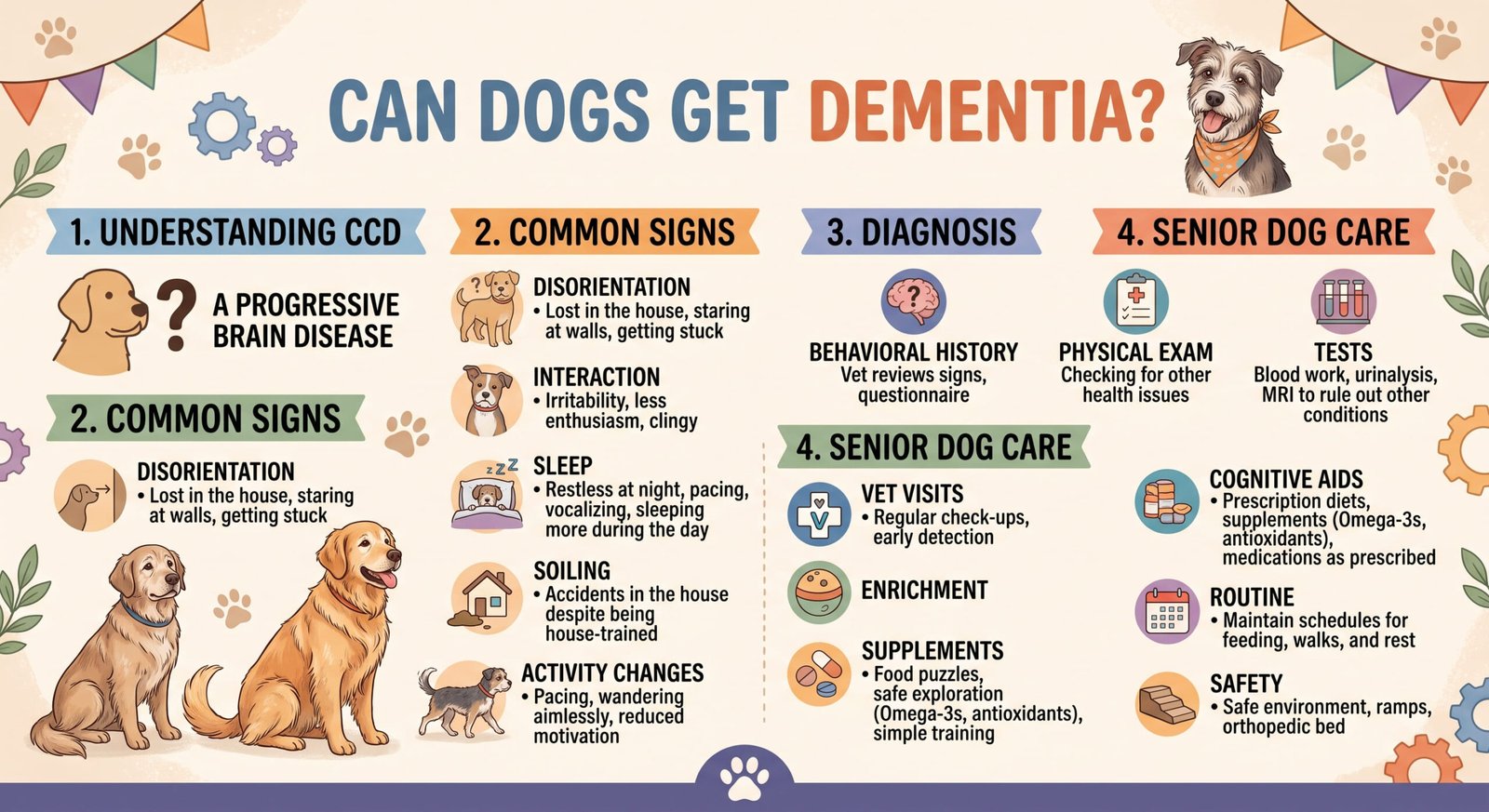
Yes, dogs can get dementia. In veterinary medicine, this condition is clinically known as Canine Cognitive Dysfunction (CCD) or Cognitive Dysfunction Syndrome (CDS). Much like Alzheimer’s disease in humans, canine dementia is an age-related neurodegenerative condition that causes progressive physical and chemical changes in the brain, leading to memory loss, disorientation, altered sleep routines, and behavioral changes.
Watching an older companion become confused or anxious can be distressing. However, understanding how cognitive decline develops—and how it differs from normal aging—helps owners take proactive steps to maintain their pet’s comfort and quality of life.
Do Dogs Go Senile? Understanding Cognitive Dysfunction Syndrome
When owners ask if dogs go senile or wonder whether dogs have dementia, they are usually noticing shifts in everyday temperament. While “senility” is an older, non-clinical term, the biological reality involves tangible neurological decline.
As dogs advance in age, their brains accumulate toxic beta-amyloid protein plaques, experience micro-strokes that reduce oxygenation, and suffer neuronal loss. The brain also produces lower levels of key neurotransmitters like dopamine. These changes degrade how an aging dog processes sensory information, navigates familiar territory, and responds to familiar routines.
Normal Aging vs. Dementia: Key Distinctions
It is common to confuse normal sensory decline with cognitive deterioration. A dog with cataracts or hearing loss may startle easily or fail to respond to commands, but their fundamental awareness remains intact.
| Feature | Normal Aging | Canine Cognitive Dysfunction (CCD) |
| Spatial Awareness | Navigates the home easily; adapts to reduced vision | Gets stuck behind doors, wedges into corners, stares blankly at walls |
| Social Engagement | May tire faster but maintains affection and greeting rituals | Withdraws, ignores family members, or exhibits sudden unprovoked irritability |
| Housetraining | Occasional accidents tied directly to mobility or kidney issues | Eliminates indoors immediately after returning from outside; loses signal cues |
| Sleep Cycles | Sleeps more heavily during the day and night | Paces, whines, or wanders restlessly at midnight while sleeping deeply all morning |
How Do I Know if My Dog Has Dementia? The DISHA Framework
Veterinarians evaluate behavioral shifts using the DISHA diagnostic framework (often expanded to DISHAL to include learning/memory changes). If you are asking, “how do I know if my dog has dementia?”, monitor whether your pet exhibits several of these core signs of doggie dementia over weeks or months:
- D – Disorientation: Wandering aimlessly, walking toward the hinge side of a door instead of the opening, failing to recognize familiar routes during neighbourhood walks, or staring into corners.
- I – Interactions: Notable shifts in social relationships. A previously affectionate pet may withdraw, avoid physical touch, or display uncharacteristic clinginess and separation anxiety.
- S – Sleep-Wake Cycle Alterations: Reversal of circadian rhythms. The dog sleeps heavily during daylight hours but wakes repeatedly during the night, pacing, vocalizing, or panting.
- H – Housetraining and Memory: Losing previously mastered behaviors. This includes eliminating indoors without signaling, forgetting basic cues, or pacing near food bowls immediately after eating.
- A – Activity Changes: A marked drop in purposeful exploration, alternating with repetitive, purposeless behaviors such as compulsive licking of surfaces or continuous pacing in circles.
- L – Learning & Anxiety: Difficulty learning new habits or adapting to minor household changes, frequently accompanied by novel phobias (such as sudden fear of standard floor surfaces or ordinary household sounds).
At What Age Do Dogs Get Dementia?
Cognitive decline correlates strongly with chronological age and lifespan expectations:
- Prevalence: Clinical studies indicate that approximately 28% of dogs aged 11 to 12 show one or more signs of cognitive decline, rising to roughly 68% of dogs aged 15 to 16.
- Breed Size Variations: Giant breeds (such as Great Danes and Mastiffs) age more rapidly and may exhibit early symptoms as early as 7 to 8 years old. Conversely, smaller breeds (such as Chihuahuas, Toy Poodles, and Dachshunds) possess longer average lifespans and rarely exhibit symptoms before age 11 or 12.
Medical Mimics: Ruling Out Other Health Conditions
Because older dogs frequently present with multiple concurrent health issues, a behavioral shift does not automatically confirm CCD. Several common geriatric medical conditions produce symptoms that closely mirror dementia:
- Arthritis and Chronic Joint Pain: Pain causes sleep fragmentation, reluctance to interact, pacing, and house-soiling due to difficulty standing or navigating stairs.
- Sensory Loss: Progressive nuclear sclerosis, cataracts, or age-related deafness can cause a dog to ignore commands or startle easily.
- Endocrine and Organ Disorders: Kidney disease, diabetes mellitus, and Cushing’s disease (hyperadrenocorticism) trigger excessive thirst and urination, frequently misdiagnosed as cognitive housetraining failure.
- Brain Tumors: Intracranial lesions or central nervous system inflammation can cause rapid-onset pacing, circling, and behavioral changes.
A comprehensive veterinary workup—including blood chemistry, urinalysis, orthopedic assessment, and a neurological evaluation—is essential before confirming a diagnosis of CCD.
Management, Treatment, and Home Adaptations
While canine dementia is progressive and has no permanent cure, early intervention can slow cognitive decline and dramatically improve daily comfort.
       [ Early Detection & Vet Evaluation ]
                        |
        +---------------+---------------+
        |                               |
[ Medical Therapies ]          [ Daily Management ]
 - Selegiline (MAO-B)           - Predictable Routines
 - Antioxidant Diets            - Non-slip Runners & Mats
 - S-adenosylmethionine (SAMe)  - Gentle Enrichment & Lighting
1. Veterinary Interventions and Nutrition
- Targeted Diets: Commercial veterinary diets enriched with medium-chain triglycerides (MCTs), omega-3 fatty acids, and antioxidants help provide alternative energy sources to aging brain cells and reduce oxidative stress.
- Approved Medications: In several countries, medications such as selegiline hydrochloride (an MAO-B inhibitor) are prescribed to help prolong dopamine activity in the central nervous system, improving wakefulness and alertness in some canine patients.
- Targeted Supplements: Nutritional supplements containing antioxidants, S-adenosylmethionine (SAMe), or apoaequorin are often recommended to support neuronal health and alleviate mild anxiety.
2. Supportive Home Modifications
Practical modifications help an older dog safely navigate the house:
- Improve Traction: Place non-slip rugs, rubber runners, or interlocking foam tiles across hardwood, laminate, or tile floors to prevent slipping and reduce walking anxiety.
- Maintain Layout Consistency: Avoid rearranging living room furniture, food bowls, or bedding. Dogs relying on spatial memory rather than clear vision can become panicked by unexpected obstacles.
- Ambient Night Lighting: Install soft plug-in nightlights near water stations, pet beds, and doorways to ease nighttime wandering and confusion caused by low-light vision loss.
- Keep Predictable Routines: Feed, walk, and settle your dog at the exact same times daily. Predictable sequences reduce underlying stress and provide structural cues throughout the day.
Frequently Asked Questions
Can dog dementia come on suddenly?
True Canine Cognitive Dysfunction typically develops gradually over several months. A sudden, dramatic behavioral shift occurring over 24 to 48 hours is more often attributable to an acute medical problem—such as a stroke, an inner ear infection affecting balance, acute pain, or a metabolic crisis—and warrants immediate veterinary attention.
What should I do if my dog gets stuck in corners?
Gently guide your dog out without scolding. Dogs with advanced cognitive decline often lose the spatial reasoning required to back up when they hit a barrier. Place physical barriers, soft cushions, or baby gates in awkward nooks to prevent them from becoming trapped.
Does walking help a dog with dementia?
Yes. Short, frequent, low-stress walks provide crucial olfactory enrichment and mental stimulation. Allowing an older dog to sniff safely activates sensory pathways in the brain. However, keep outings predictable, avoid loud unfamiliar environments, and keep your dog securely on a leash to prevent them from wandering off.
When is it time to consider end-of-life care for a dog with dementia?
Evaluating quality of life involves monitoring your dog’s comfort, dignity, and basic daily functions. When confusion causes unrelenting terror, distress, or severe sleep deprivation that no longer responds to environmental management and medication, discuss a humane quality-of-life assessment with your veterinarian.
Supporting Your Senior Companion
Navigating canine cognitive decline requires patience, keen observation, and close collaboration with your veterinarian. While an aging brain faces inevitable changes, identifying symptoms early, optimizing your home environment for stability, and ruling out concurrent physical pain will help your companion stay secure, oriented, and comfortable throughout their senior years.